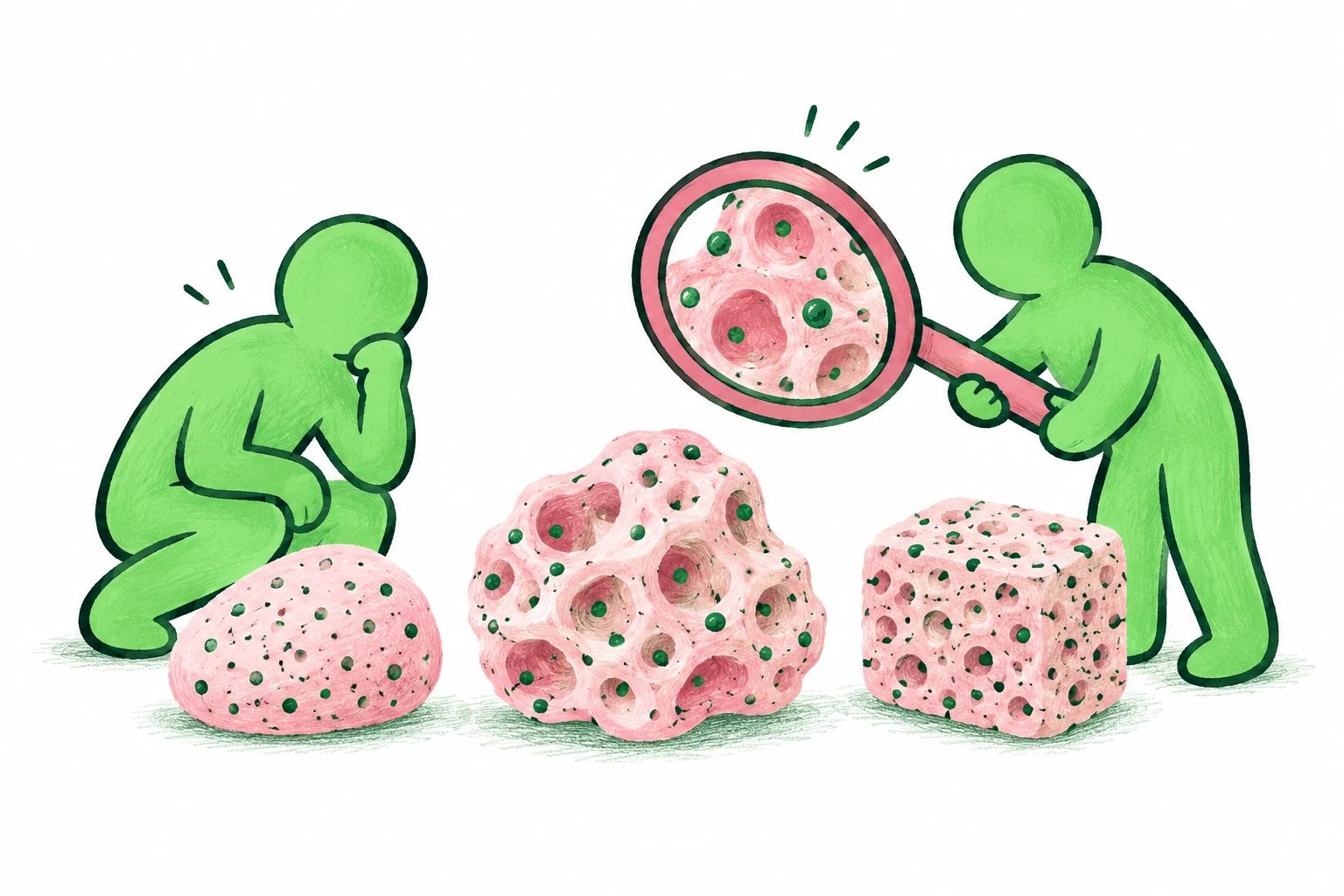
Molecular-sieve materials help many oxygen concentrators separate nitrogen from air. Names such as 13X, LiX and LiLSX describe related adsorbents, not complete medical-device performance grades. They can explain an engineering choice, but cannot tell a buyer whether a machine meets a prescription or how long it will last.
What the names describe
Zeolites are porous crystalline materials. Their internal structure and charge-balancing ions influence how gases are adsorbed—held on surfaces within the material. In oxygen separation, the aim is to retain nitrogen preferentially while producing an oxygen-enriched stream.
13X commonly refers to a sodium-form X-type zeolite. LiX refers to lithium-exchanged X-type material. LiLSX denotes lithium-exchanged low-silica X zeolite. These labels do not fully describe a commercial formulation, pellet structure or assembled sieve cartridge.
Why the material matters
Changing the ions can change gas adsorption. Primary experiments comparing ion-exchanged LSX materials found that nitrogen/oxygen separation depends on material, temperature and pressure. A result under particular experimental conditions is not a guarantee of the same advantage in every finished machine.
The concentrator also relies on its compressor, valves, filtration, bed geometry and operating cycle. Research on medical oxygen concentration examines the material within such a process. A technically promising adsorbent does not, by itself, establish clinical suitability, noise, battery life or reliability.
What buyers can verify
If a material claim matters to a purchase, request an explicit statement for the exact model from the manufacturer. Do not infer the sieve from the machine's weight, its country of origin, a seller's “premium” label or the price of a replacement part. If the composition is not disclosed, say that it is unknown rather than assigning a likely material.
Compare documented output at the required flow, operating conditions, alarms, supported accessories and local service arrangements. These are more directly useful to the household than a ranking based on chemistry alone. The manufacturer-check guide explains how to match claims to product documents.
Material labels are not repair instructions
A bag of adsorbent with the same name is not automatically a compatible replacement for a factory assembly. Do not open, refill or heat a sieve bed at home. Ask the service provider to identify the supported replacement part and verification required after repair.
Likewise, do not infer a service interval from the adsorbent name or apply a universal humidity penalty. Use the model's maintenance information and actual assessment. The covers the records and questions that support that decision without predicting a component's remaining life.